Modality-native
bioprocess intelligence.
From Bench to Scale. BioAna connects process and quality data, scientific context and real-time operations with predictive and simulation intelligence - so teams can understand, predict, simulate and decide with confidence.
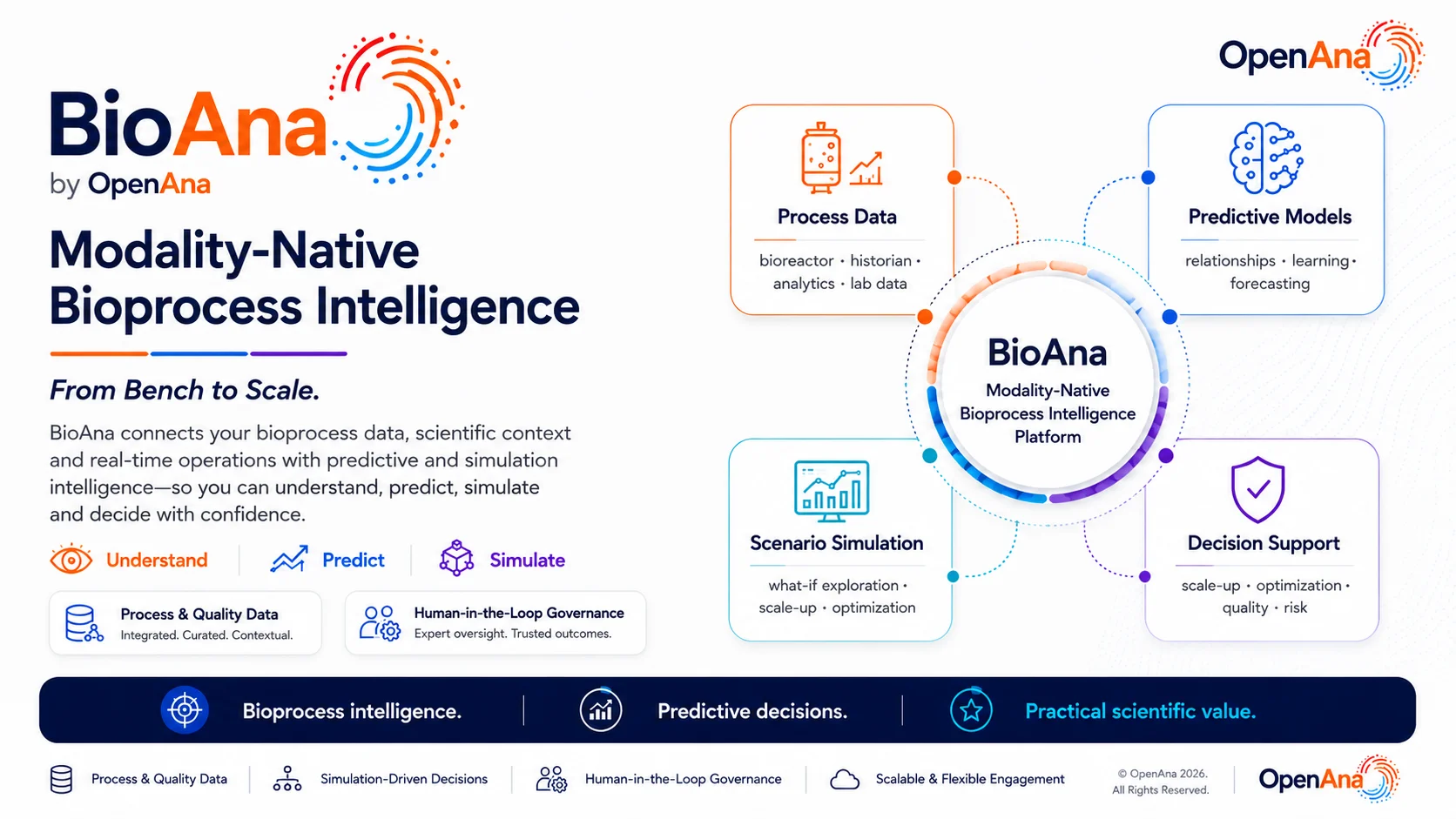
Understand every run
Curated, contextualized process and quality data
Predict what happens next
Hybrid models, simulation and scale-up intelligence
Decide with confidence
Human-in-the-loop, governed scientific workflows
Physical experimentation is essential. It should not carry the whole burden.
Complex biology makes every run valuable - but much of what is learned remains fragmented across systems, difficult to compare and slow to reuse.
Process inputs
Operating conditions, media, feed, pH, temperature and geometry.
Biology responds
Growth, metabolism, viability, stress and cellular state.
Quality emerges
Titer, yield, CQAs, potency and consistency.
More experiments
High cost, long cycle time and limited operating-window coverage.
Slower learning
Insights arrive only after the run is complete.
Fragmented knowledge
Data, models and SME knowledge remain disconnected.
Connect the process. Understand the science. Predict what happens next.
BioAna is OpenAna's specialized biopharma intelligence platform: a connected data foundation, a predictive digital twin and an enterprise layer that makes the system secure, traceable and operational.
01 / CONNECT & CONTEXTUALIZE
BioAna Hub
Modality Data & Context Engine
- Real-time and historical ingestion
- Run mapping and time alignment
- Scientific contextualization
- Quality validation and unified namespace
02 / PREDICT & SIMULATE
BioAna Twin
Predictive & Simulation Engine
- Mechanistic and cellular models
- Hybrid AI/ML intelligence
- Scenario and scale-up simulation
- Uncertainty and operating windows
03 / GOVERN & SCALE
BioAna OS
Enterprise, Connectivity & Governance Layer
- Security, RBAC and auditability
- Model lifecycle and APIs
- Workflow integration
- Enterprise and GxP readiness
Hub knows what happened. Twin predicts what could happen. BioAna helps determine what should happen next.
Every run strengthens the context, the model and the next decision.
BioAna can remain connected to the process - not merely ingest yesterday's dataset.
Connect
Bioreactors, PAT, historians, ELN, LIMS, MES and files
Contextualize
Align runs, events, materials, equipment, assays and quality
Predict
Model behavior, simulate scenarios and quantify uncertainty
Decide
Scientist reviews, compares and approves the next action
Learn
New evidence returns to Hub and improves future intelligence
Physics constrains. Data grounds. AI learns. Science guides.
A useful digital twin is not a black box. BioAna combines process mechanics, biological response, observed evidence and domain knowledge into scientifically constrained prediction.
Process physics
- Mixing and hydrodynamics
- Mass transfer, kLa and OTR
- Shear, heat and scale effects
- Geometry and operating conditions
Biology + data + AI
- Historical runs and assays
- Cellular kinetics and response
- Multivariate and AI/ML models
- SME and prior knowledge
BioAna Twin
Scientifically constrained digital twin
One platform does not mean one generic model.
A temperature reading only becomes useful when BioAna understands the step, cell system, equipment, scale, biological state, relevant CPPs and affected CQAs.
01 / Biologics
From cell culture to predictive scale-up
- Context
- mAbs, recombinant proteins, media, feeds, bioreactor signals, metabolites and CQAs.
- Twin
- Growth kinetics, metabolic behavior, kLa/OTR, mixing, titer and scale effects.
- Decisions
- Feed strategy, operating window, scale-up, tech transfer and comparability.
02 / Cell Therapy
Manage variability across a living process
- Context
- Starting material, activation, expansion, transduction, phenotype and potency.
- Twin
- Cell-state evolution, variability, critical stage transitions and outcome prediction.
- Decisions
- Expansion strategy, consistency, potency risk and manufacturing readiness.
03 / Gene Therapy
Predict yield, quality and robustness
- Context
- AAV, lentiviral and adenoviral processes, cell systems, harvest and purification.
- Twin
- Vector yield, quality, kinetics, sensitivity and scale behavior.
- Decisions
- Yield, robustness, quality risk, process conditions and scale-up.
04 / Fermentation
Control growth, oxygen and productivity
- Context
- Bacterial, yeast and precision fermentation; feed, oxygen, heat and induction.
- Twin
- High-density growth, OUR/OTR, substrate kinetics and oxygen limitation.
- Decisions
- Feed profile, induction, productivity, cooling and scalable operating windows.
05 / RNA & Oligo
Optimize yield, purity and product quality
- Context
- ASO, siRNA and related workflows; synthesis, purification and analytics.
- Twin
- Yield, impurity progression, potency, quality and process sensitivity.
- Decisions
- Conditions, purification strategy, robustness and quality progression.
06 / Multi-Program
CDMO intelligence across clients and modalities
- Context
- Multiple clients, sites, processes and modalities in one governed tenant.
- Platform
- Client isolation, reusable knowledge and process-specific models.
- Decisions
- Standardized operations, cross-program learning and scalable deployment.
A connected scientific decision system
Not just data. Not just a model. Not just AI.
BioAna connects process data, predictive models, scenario simulation and governed decision support around the science of each modality.
Others solve pieces. BioAna connects the whole decision system.
The difference is the integrated path from raw process evidence to modality-aware, scientifically constrained and governed decisions.
| Capability | Data platform | Digital twin tool | AI/ML platform | BioAna |
|---|---|---|---|---|
| Real-time process connectivity | Yes | Some | Some | Yes |
| Contextualized bioprocess data | Some | Limited | Limited | Yes |
| Modality-native semantics | - | Some | - | Yes |
| Mechanistic + AI/ML modeling | - | Partial | Partial | Yes |
| Scale-up and scenario simulation | - | Yes | Some | Yes |
| CQAs and process outcomes | Limited | Some | Some | Yes |
| Continuous intelligence loop | - | Limited | Some | Yes |
| Enterprise governance | Yes | Limited | Yes | Yes |
| Multi-modality platform | Some | - | Generic | Yes |
Multiple high-value decisions.
The same connected foundation supports decisions from early development through commercial manufacturing.
Development
Process development
Design smarter experiments and learn from every run.
Scale
Scale-up optimization
Predict larger-scale behavior before committing material and time.
Performance
Feed / process optimization
Tune operating conditions and explore feasible windows.
Quality
Product quality prediction
Connect CPPs to CQAs and anticipate quality outcomes.
Transfer
Tech transfer
Carry process knowledge across equipment, sites and teams.
Operations
Manufacturing support
Support deviations, RCA, comparability and continuous improvement.
Adopt in stages. Build reusable intelligence.
Start with the data and context already available, validate intelligence against real runs, then operationalize it across workflows.
STEP 01
Connect
BioAna Hub
Connect process and quality data and build modality-aware context.
STEP 02
Understand & predict
BioAna Twin
Build and validate hybrid models; explore scale-up scenarios.
STEP 03
Operationalize
BioAna OS
Integrate decisions into governed scientific workflows.
STEP 04
Learn
Continuous intelligence
Every new run generates evidence that strengthens the system.
Who uses BioAna.
From bench scientists to CDMO leadership, BioAna gives every role a shared, modality-aware view of process and quality.
Process Development Scientist
Design smarter experiments, compare runs instantly, and turn every batch into reusable modeling context instead of a one-off dataset.
MSAT / Tech Transfer Lead
Carry process knowledge across equipment, sites and scales with a shared context model instead of static reports and tribal knowledge.
Manufacturing & MFG Science
Support deviations, root-cause analysis and comparability with a model that understands CPPs, CQAs and equipment-specific behavior.
Quality & CQA Owners
Connect critical process parameters to critical quality attributes and anticipate quality outcomes before the run finishes.
CDMO Program & Ops Leadership
Run multiple clients, sites and modalities in one governed tenant with client isolation and cross-program learning.
Data / Digital & IT Leaders
Get a governed, auditable data and model layer that connects historians, ELN, LIMS and MES without another data swamp.
Connects to the systems your teams already use.
BioAna Hub ingests real-time and historical data across the bioprocess stack - no rip-and-replace required.
Bioreactors & PAT
Single-use and stainless bioreactors, Raman, capacitance, and other in-line process analytical technology
Historians & SCADA
PI System, Aveva, Delta V and other real-time and historical process data sources
ELN / LIMS
Electronic lab notebooks and laboratory information management systems for assays and sample data
MES & Batch Records
Manufacturing execution systems and electronic batch records for run and event context
Quality & QMS
Deviation, CAPA and quality management systems for CQA and investigation context
Files & Flat Data
CSV, spreadsheets and other unstructured or semi-structured process and quality files
Questions we hear most.
Does BioAna replace physical experimentation?
No. BioAna reduces how many experiments are needed to reach a decision by turning every run into reusable, modality-aware context and simulation intelligence - physical validation remains part of the workflow.
Does BioAna make quality or regulatory decisions?
No. BioAna prepares evidence-linked predictions and scenario comparisons; scientists and accountable reviewers make all quality, process and regulatory decisions.
What data does BioAna need to get started?
BioAna connects to bioreactors, PAT, historians, ELN, LIMS, MES and flat files. Teams can start with the data and context already available and expand connectivity over time.
How does BioAna handle multiple modalities in one tenant?
Each of the six program modules carries its own modality-native context, vocabulary and models, while sharing a common platform core for runs, materials, equipment, security and governance.
Is BioAna suitable for CDMOs with multiple clients?
Yes. The Multi-Program module supports client isolation, reusable knowledge and process-specific models across clients, sites and modalities in one governed tenant.
What does "enterprise governance" mean in BioAna OS?
BioAna OS provides security, role-based access control, auditability, model lifecycle management and workflow integration so scientific decisions stay traceable and enterprise-ready.
BioAna by OpenAna
From every run to reusable intelligence to better decisions at scale.
One platform. Modality-specific science. Better decisions at every scale.
Explore BioAna